Life constantly moves through phases of change, where endings and beginnings often occur side by side. People experience situations such as losing opportunities, facing setbacks, or dealing with unexpected transitions. In such moments, attention naturally shifts toward what has been lost, making it difficult to notice what may still be possible.
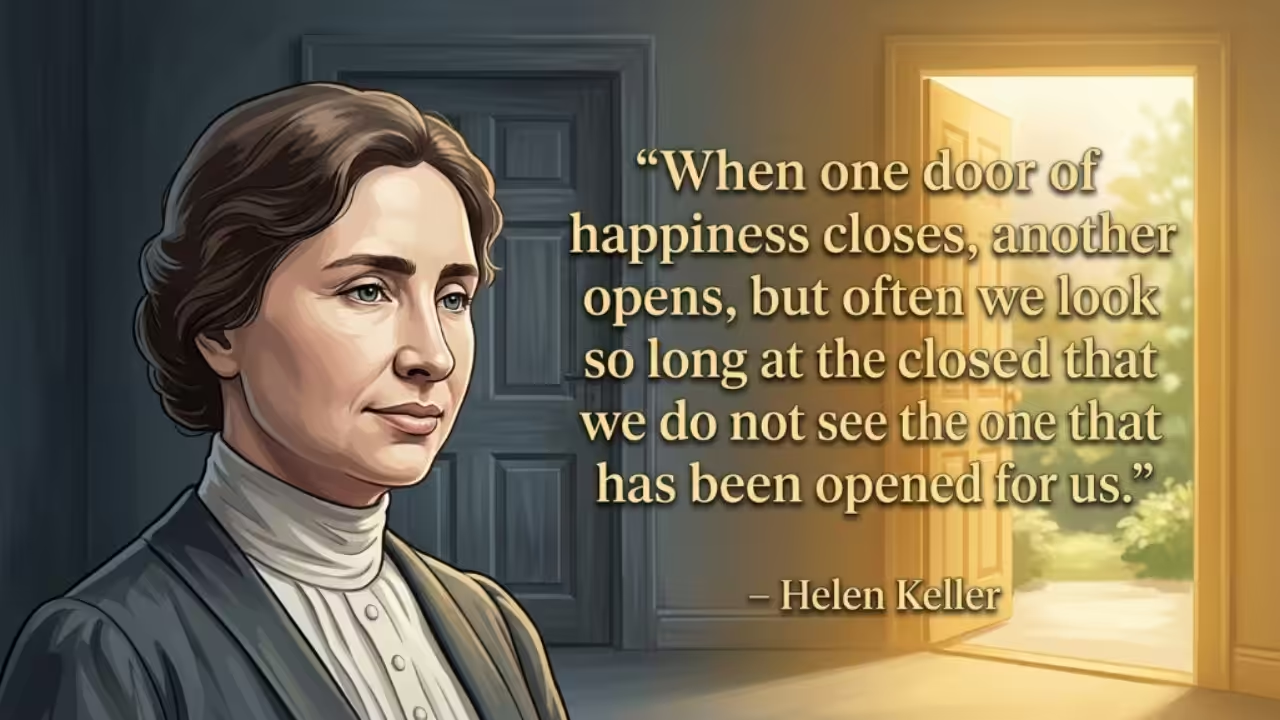
The well-known quote by Helen Keller, “When one door of happiness closes, another opens, but often we look so long at the closed door that we do not see the one that has been opened for us,” explains this pattern clearly. It highlights how human perception plays a central role in how individuals interpret life events.

This statement is widely referenced in educational and psychological discussions because it describes a real and observable behavior. It does not suggest that loss can be avoided, but it explains that new possibilities often exist alongside it. Recognizing those possibilities depends on awareness and the direction of attention.
Table of Contents
Understanding the Core Meaning of the Quote
The quote presents a simple sequence: one opportunity ends, and another begins. The “closed door” represents a loss, such as failure, disappointment, or change. At the same time, the “open door” represents a new path or opportunity that becomes available.
However, the quote focuses more on human response than on the events themselves. People tend to focus heavily on what has ended. This focus can limit their ability to recognize what has newly emerged. The issue is not the absence of opportunities but the inability to see them.

From a factual standpoint, the quote originates from Helen Keller’s work We Bereaved (1929), where it was used to explain emotional adaptation and acceptance of change. It continues to be cited in educational and psychological contexts due to its clarity and relevance.
Helen Keller’s Life and Its Connection to the Quote
Helen Keller was born in 1880 in Tuscumbia, Alabama. At the age of 19 months, she lost both her sight and hearing due to illness. Despite this, she developed communication skills through the guidance of her teacher Anne Sullivan.
She later became the first deafblind individual to earn a Bachelor of Arts degree from Radcliffe College. Over time, she became an author, lecturer, and advocate for disability rights, working with organizations such as the American Foundation for the Blind.

Her life demonstrates the principle expressed in the quote. Instead of focusing on her limitations, she adapted to new ways of learning and communication. This allowed her to achieve significant milestones, showing how new opportunities can be recognized even under restrictive conditions.
Psychological Explanation Behind the Quote
The ideas expressed in the quote are supported by established concepts in psychology. Human attention is limited, and individuals often prioritize emotionally significant events, especially negative ones.
According to American Psychological Association, attention and perception influence how people interpret their surroundings. When individuals focus heavily on negative experiences, such as loss or failure, they reduce their ability to notice new information or opportunities.
In addition, studies in behavioral science show that people are more sensitive to losses than gains. This pattern explains why individuals may continue focusing on a “closed door” even when another opportunity is available. The quote aligns with these findings by describing a common cognitive behavior rather than offering abstract advice.
Real-Life Situations Where the Quote Applies
The relevance of this quote can be observed across different areas of life. In employment, job loss is often viewed as a negative outcome. However, workforce data shows that career transitions frequently lead to new roles, improved skills, or different professional directions.
In education, students who do not achieve expected results often pursue alternative paths that better match their abilities. This demonstrates how a closed opportunity can lead to another form of progress.
In personal life, changes such as relocation or ending relationships can create new environments and experiences. These situations show that opportunities are often present, but recognizing them depends on awareness and focus, as explained in the quote.
Key Lessons Highlighted by the Quote
The quote provides clear observations about human behavior and adaptation. These lessons are based on real-life patterns and supported by psychological understanding.
- Attention Determines Awareness: Individuals notice what they focus on.
- Change is Continuous: Endings and beginnings are natural parts of life.
- Opportunities Coexist with Loss: New possibilities often appear alongside setbacks.
- Recognition Requires Shift in Focus: Awareness improves when attention moves forward.
These points reflect observable human responses rather than opinions, making the quote practical for understanding everyday situations.
Why This Quote Remains Relevant Today
In modern society, rapid changes in technology, employment, and social structures create frequent transitions. Individuals are often required to adapt to new roles, industries, and environments.
Reports from the World Economic Forum indicate that people are likely to experience multiple career changes during their lifetime. This increases the importance of recognizing new opportunities rather than focusing only on past situations.
The quote remains relevant because it explains a consistent pattern in human behavior. It provides a clear framework for understanding how people respond to change and how they can improve their awareness during transitions.
The quote by Helen Keller explains how individuals respond to loss and opportunity through the lens of attention and perception. It highlights that while setbacks are unavoidable, new possibilities often exist at the same time.
The key idea is not about avoiding challenges but about recognizing what comes next. By shifting focus from what has ended to what is available, individuals can better adapt to change.
Supported by psychological concepts and real-life examples, this quote remains a practical explanation of human behavior. It continues to be relevant because it addresses how people think, react, and move forward in changing circumstances.